ScaffoldGraph?
Paper
Scott, Oliver B., and A. W. Edith Chan. "ScaffoldGraph: an open-source library for the generation and analysis of molecular scaffold networks and scaffold trees." Bioinformatics 36.12 (2020): 3930-3931.
ScaffoldGraph는 open source로 scaffold를 쉽게 추출하고 분석하기 위한 python library 및 CLI tool 입니다.
논문의 내용도 중요하지만 빠르게 사용하고 싶으시다면 github를 먼저 참조하시는 것을 추천드립니다. 진짜 사용하기 편한 점은 install이 정말 쉽다는 점..기존 기능들을 잘 정리하고 업데이트 해서 다목적으로 활용하기 좋습니다.
- ScaffoldGraph currently supports Python 3.6 and above.
conda config --add channels conda-forge
conda install -c uclcheminformatics scaffoldgraph
# Basic installation.
pip install scaffoldgraph

# Install with ipycytoscape.
pip install scaffoldgraph[vis]

# Install with rdkit-pypi (Linux, MacOS).
pip install scaffoldgraph[rdkit]

# Install with all optional packages.
pip install scaffoldgraph[rdkit, vis]
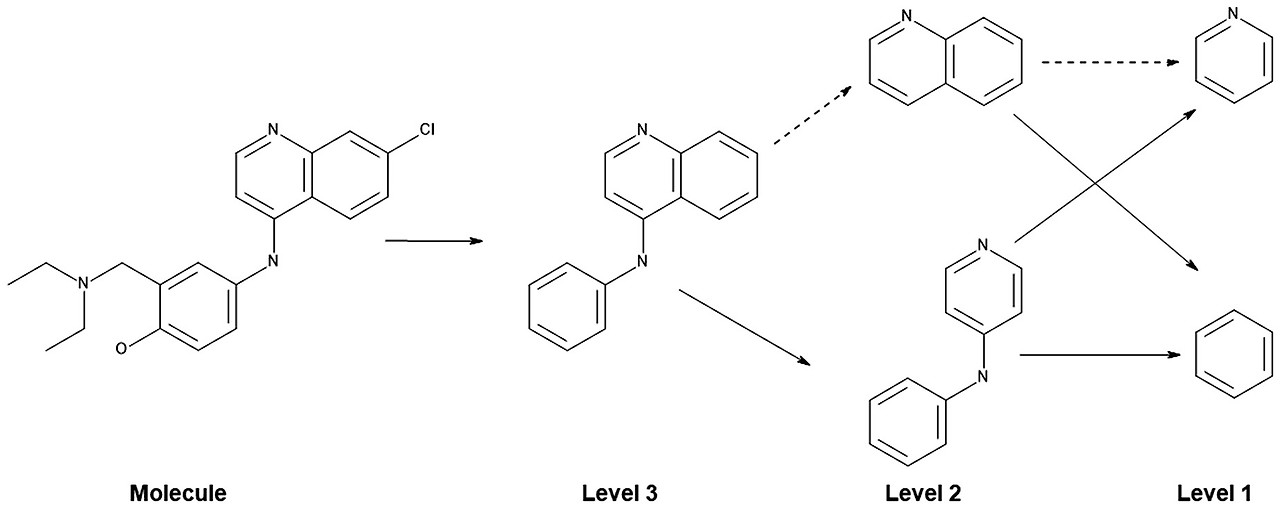
논문에서는 딱 한 개의 figure만 존재합니다. Scaffold는 분자의 중심 구조를 나타내는 의약화학 분야에서 널리 사용되는 개념인데, 분자의 어느 부분을 중심 구조로 정할 것인지 컴퓨터 기반으로 연구할 때 주관적이거나 모호할 수 있습니다.
Paper
Bemis, Guy W., and Mark A. Murcko. "The properties of known drugs. 1. Molecular frameworks." Journal of medicinal chemistry 39.15 (1996): 2887-2893.
Scaffold 하면 가장 유명한 논문 중 하나입니다. Bemis와 Murcko의 정의는 이러한 모호성을 무시하고, scaffold를 ring들과 이들을 연결하는 link atom으로 정의합니다. 그 뒤로 scaffold tree, scaffold network 등 계속해서 scaffold에 관한 연구는 계속되어 왔습니다. Figure 1을 살펴보면 Level 3는 Bemis와 Murcko 정의에 따른 scaffold입니다. 그 뒤로 점선으로 표시된 경로는 scaffold tree 방식을 의미하고, scaffold network는 전체를 포함합니다. HierS Network 방식도 그림에는 나타나있지 않지만 ScaffoldGraph 옵션에 있습니다. HierS는 fused ring을 분해하지 않습니다. (code처럼 break_fused_rings = False 해주면 된다.)
# We can also force the fragmenter not to break fused ring systems

frags = sg.get_all_murcko_fragments(mol, break_fused_rings=False)
Draw.MolsToGridImage(frags)
[Scaffold network 와 scaffold tree 참고 그림]
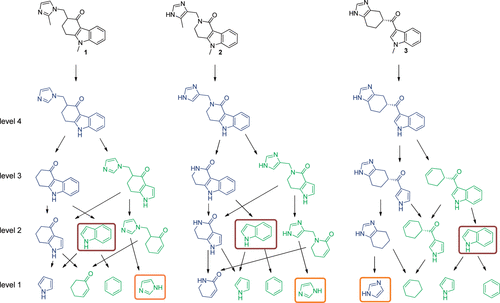
그림에서 파랑색 compound는 scaffold tree 결과물이고 전체는 scaffold network 결과물입니다. 두 방식은 모두 Bemis-Murcko scaffold로 시작합니다. 이 방식은 모든 고리의 치환기를 제거하고 ring system과 이를 연결하는 linker만 남기는 방식이기 때문에 예를 들어, scaffold hopping을 하기 위해서는 너무 많은 sub structure를 포함하고 있다고 볼 수 있습니다. scaffold tree 같은 경우에는 exocyclic과 exolinker의 이중 결합은 유지됩니다. 이렇게 생성된 scaffold 들을 child scaffold로 정하고 주변의 말단 고리를 반복적으로 제거하면서 parent scaffold를 계산하고 더 이상 제거할 고리가 없을 때 해당 scaffold를 level 1로 정의합니다. Scaffold network는 scaffold tree를 기반으로 하지만 각 level에서 하나의 특정 scaffold만 선택하는 규칙을 적용하지 않는 것이 특징입니다.
[HierS 참고 그림]
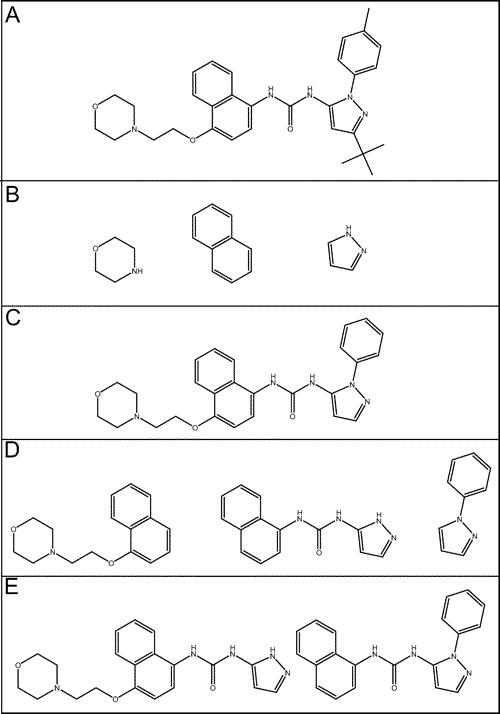
HierS의 Scaffold tree & network와 가장 큰 차이점은 fused ring을 pruning (가지치기) 과정에서 제거하지 않는다는 점입니다.
[ScaffoldGraph]
| Features | PMID | information |
| BM scaffold | 8709122 | Murcko Fragment generation (Bemis, 1996) |
| scaffold tree | 17238248 | Scaffold Tree generation (Schuffenhauer, 2007) |
| scaffold network | 21615076 | Scaffold Network generation (Varin, 2011) |
| HierS network | 15857124 | HierS Network Generation (Wilkens, 2005) |
Github - example - basic function
# Import scaffoldgraph
import scaffoldgraph as sg

# Import rdkit
from rdkit.Chem import Draw
from rdkit import Chem
# Create a molecule from a SMILES string

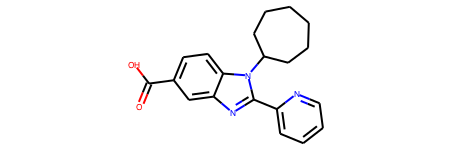
mol = Chem.MolFromSmiles('O=C(O)c1ccc2c(c1)nc(-c1ccccn1)n2C1CCCCCC1')
mol
# We can generate all possible murcko fragments using scaffoldgraph
# returned fragments are rdkit molecules

frags = sg.get_all_murcko_fragments(mol)
Draw.MolsToGridImage(frags)
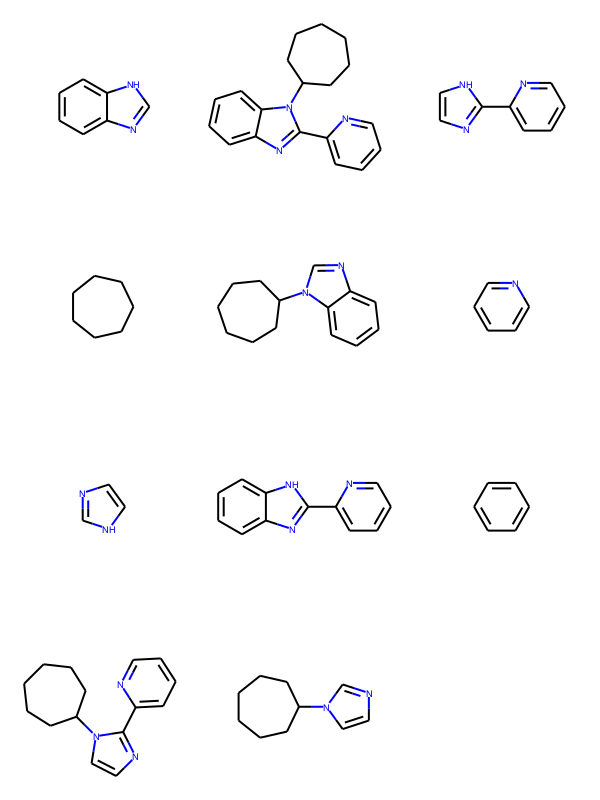
# We can also force the fragmenter not to break fused ring systems

frags = sg.get_all_murcko_fragments(mol, break_fused_rings=False)
Draw.MolsToGridImage(frags)

# Instead of returning all possible fragments we can just return the next hierarchy
# This method assumes that a murcko scaffold is supplied

scaffold = Chem.Scaffolds.MurckoScaffold.GetScaffoldForMol(mol)
frags = sg.get_next_murcko_fragments(scaffold)
Draw.MolsToGridImage(frags)
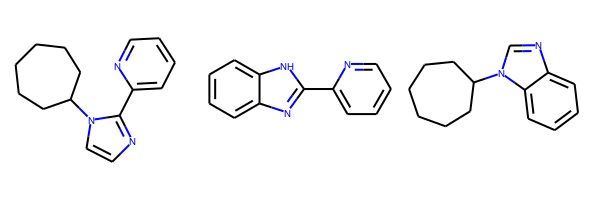
# We can also force this method to not break fused ring systems

frags = sg.get_next_murcko_fragments(scaffold, break_fused_rings=False)
Draw.MolsToGridImage(frags)
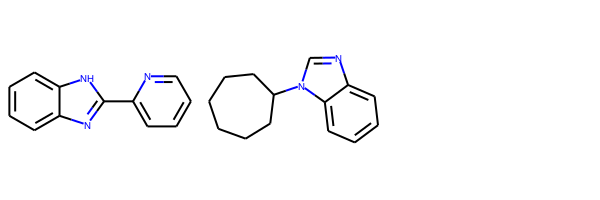
# Scaffoldgraph can also create murcko fragments using the scaffold tree method
# The rules used to prioritize fragments are the same as the original publication

frags = sg.tree_frags_from_mol(mol)
Draw.MolsToGridImage(frags)
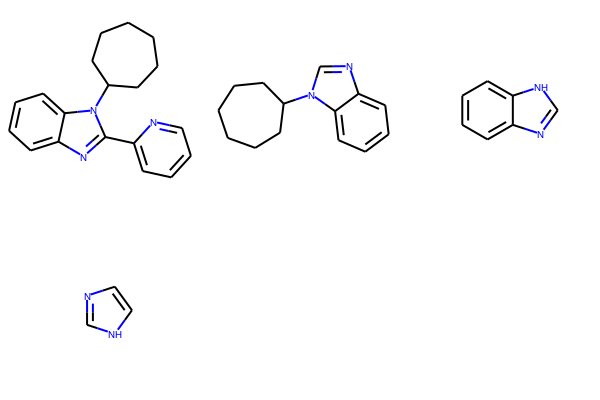
Reference
- Scott, Oliver B., and A. W. Edith Chan. "ScaffoldGraph: an open-source library for the generation and analysis of molecular scaffold networks and scaffold trees." Bioinformatics 36.12 (2020): 3930-3931.
- Kruger, Franziska, Nikolaus Stiefl, and Gregory A. Landrum. "rdScaffoldNetwork: the scaffold network implementation in RDKit." Journal of chemical information and modeling 60.7 (2020): 3331-3335.
- GitHub - UCLCheminformatics/ScaffoldGraph: ScaffoldGraph is an open-source cheminformatics library, built using RDKit and NetworkX, for the generation and analysis of scaffold networks and scaffold trees.
- Bemis, Guy W., and Mark A. Murcko. "The properties of known drugs. 1. Molecular frameworks." Journal of medicinal chemistry 39.15 (1996): 2887-2893.
- 현재 관련 분야를 공부하고 있는 전문가가 아닌 학생이기 때문에 틀린 내용이 있을 수 있습니다.
- 오타와 틀린 부분을 댓글로 알려주시면 수정하도록 하겠습니다.
'Paper > Review' 카테고리의 다른 글
| [Paper review] Hinge binder 개념 및 데이터베이스 (2) | 2025.08.08 |
|---|---|
| [Paper review] ElectroShape 개념 (3) | 2025.07.30 |
| [Paper review] Synthetic lethality 관련 정리 (1) | 2025.07.22 |
| [Paper review] Scaffold hopping 관련 정리 (1) | 2025.07.17 |
| [Paper review] Activity cliffs 관련 정리 (0) | 2025.07.04 |